
Tag Archives: time

Windows Server 2022: Configure NTP Time Synchronisation

This guide explains how to configure Windows Server 2022 to synchronise time with an external Network Time Protocol (NTP) source in an Active Directory environment. The normal design is to configure the PDC Emulator in the forest root domain to use an external time source. Other domain controllers, member servers and workstations should normally continue to synchronise through the Active Directory domain hierarchy.

If you are maintaining an older environment, see the companion guide for configuring external NTP time synchronisation on Windows Server 2008 R2 SP1.

Accurate time is important for Active Directory and Kerberos authentication. If clocks drift too far apart, users and services can experience authentication problems.

Important: These instructions are for a conventional AD DS domain. Do not configure every domain controller to use an external NTP server. In a multi-domain forest, identify the PDC Emulator in the forest root domain, not simply the PDC Emulator in the domain you happen to be working in.

Continue reading →

Windows Server 2008 R2 SP1 – How to Sync Time from External Time Source?

Windows_Server_2008_R2_Logo

This is an older Windows Server 2008 R2 SP1 walkthrough. For a current Windows Server deployment, see the updated guide to configuring external NTP time synchronisation on Windows Server 2022.

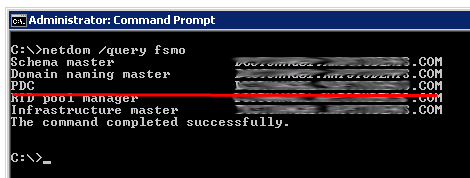
Quick post to show how you can sync your domain controllers with external time source (time.windows.com or ntp.pool.org for example). By default, all machines in the domain will sync time from the domain controller which is the internal time server – if you have more than one DC then time will sync from the DC that holds the PDC emulator FSMO role. To check which DC is PDC emulator in your domain you need to run netdom /query fsmo command like so:

Windows_Server_2008_R2_SP1_How_to_Sync_Time_to_External_Time_Source_1

Once PDC emulator role is established there is few commands we need to run in order for time to sync, these are (run on PDC emulator):

Continue reading →